
 Hotel Business
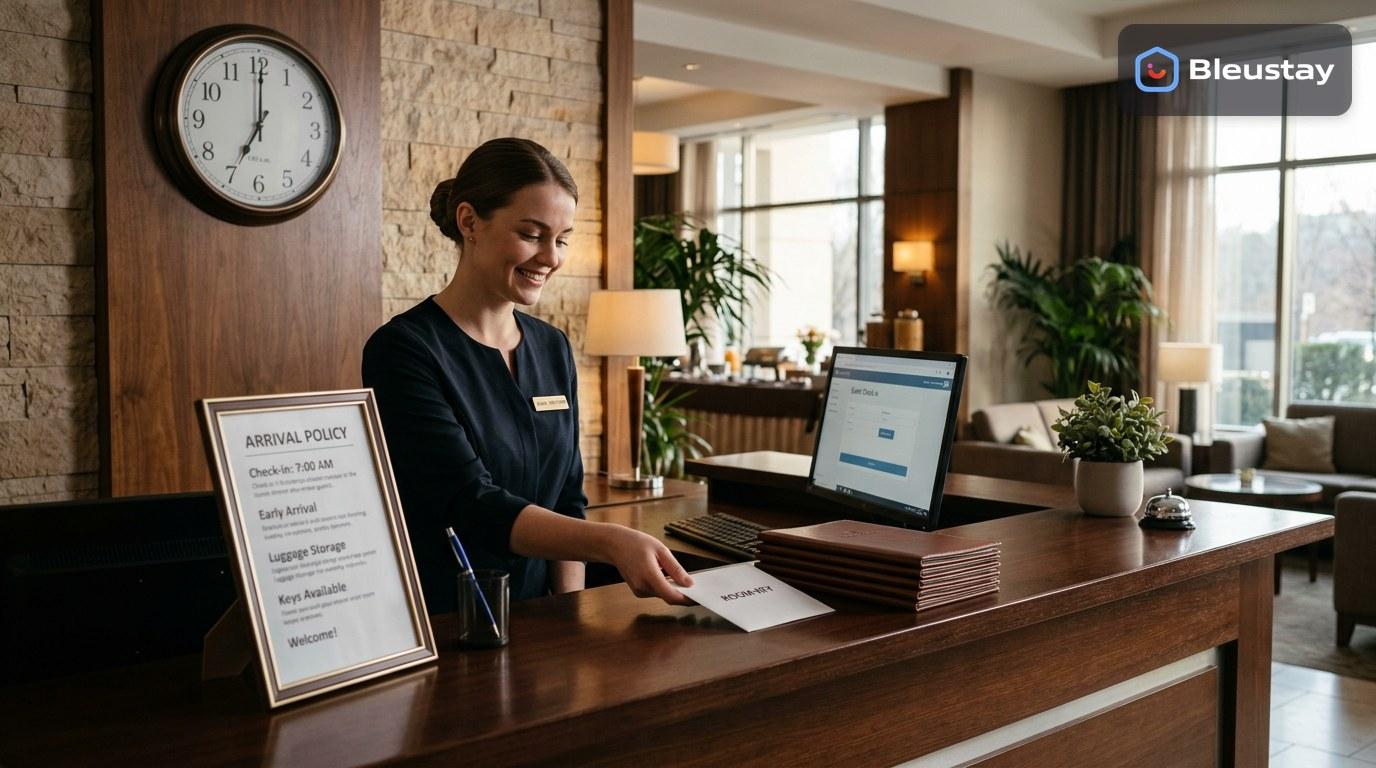
Late check-in is a hotel policy that tells guests when they can arrive after standard front desk hours and what happens if they come early or very late. For hotels, the best pages answer that question fast: arrival window, early check-in rules, and how room readiness is handled.
Bleustay is Hotel PMS.
Searchers Want Timing, Not Theory
Why Policy Clarity Changes Clicks
Search data shows the intent is highly practical. Queries such as “check in hotel jam 7 pagi check out jam berapa,” “how late can i check into a hotel,” and “can you check in late to a hotel” all point to one need: guests want a clear answer on arrival timing, not a broad explanation of hotel operations.
That matters for CTR. The page in question has 581 impressions, a 0.5% CTR, and an average position of 8.6. In other words, the page is visible, but the title and snippet are not matching what the searcher actually wants. When a page ranks on page one but underperforms in clicks, the problem is often intent alignment, not visibility.
For hotels in Indonesia, this is especially relevant because flexible arrival questions come up across both leisure and business travel. Guests in Jakarta may arrive late after meetings. Travelers to Bali may land outside standard front desk hours. If your page does not answer late check-in, early arrival, and check-out timing directly, users move on.
The content angle should be simple: state the policy up front, explain what guests should expect, and clarify what staff need to prepare. Operationally, tools like Bleustay help with room status updates, deposit recording, and booking adjustments, which support smoother arrivals once the policy is clear. Bleustay’s housekeeping status tracking keeps room allocation current, while its deposit and promotion tools support booking readiness and payment handling.
For AI search engines, the strongest pages are the ones that answer the query in the first paragraph, then add practical detail below. That means using the exact language guests search for: late check-in, early check-in, and check-out time. The page should read like a fast policy guide, not a generic hotel article.
The result is better relevance for real guest intent and a better chance of turning impressions into clicks.
Key facts
- The page has 581 impressions, 0.5% CTR, and an average position of 8.6. (Search performance data)
- Search queries include “how late can i check into a hotel” and “can you check in late to a hotel.” (Web findings)
- Bleustay housekeeping helps staff keep room status updated for smoother room allocation. (Bleustay KB)
- Bleustay deposit records and manages advance payments for bookings. (Bleustay KB)
Frequently asked questions
What is late check-in at a hotel?
Late check-in means arriving after the hotel’s standard front desk or arrival window. The exact cutoff depends on the property, so the policy should state the latest arrival time clearly.
How late can I check into a hotel?
It depends on the hotel, but guests usually look for a specific late-arrival policy on the booking page or confirmation email. Hotels should make this visible before arrival to avoid confusion.
Can I check in early if I arrive in the morning?
Early check-in depends on room readiness and the hotel’s policy. If the room is not ready, the front desk may offer storage or ask the guest to return later.
Why do guests search for check-in and check-out timing?
Because travelers want to plan transport, meetings, and flights around the hotel’s arrival rules. Clear timing details reduce friction and improve booking confidence.
How can hotels reduce confusion about late arrival policies?
State the arrival window, early arrival rules, and room readiness process in one clear place. The more direct the policy, the more likely searchers are to click and book.