
 F&B
F&B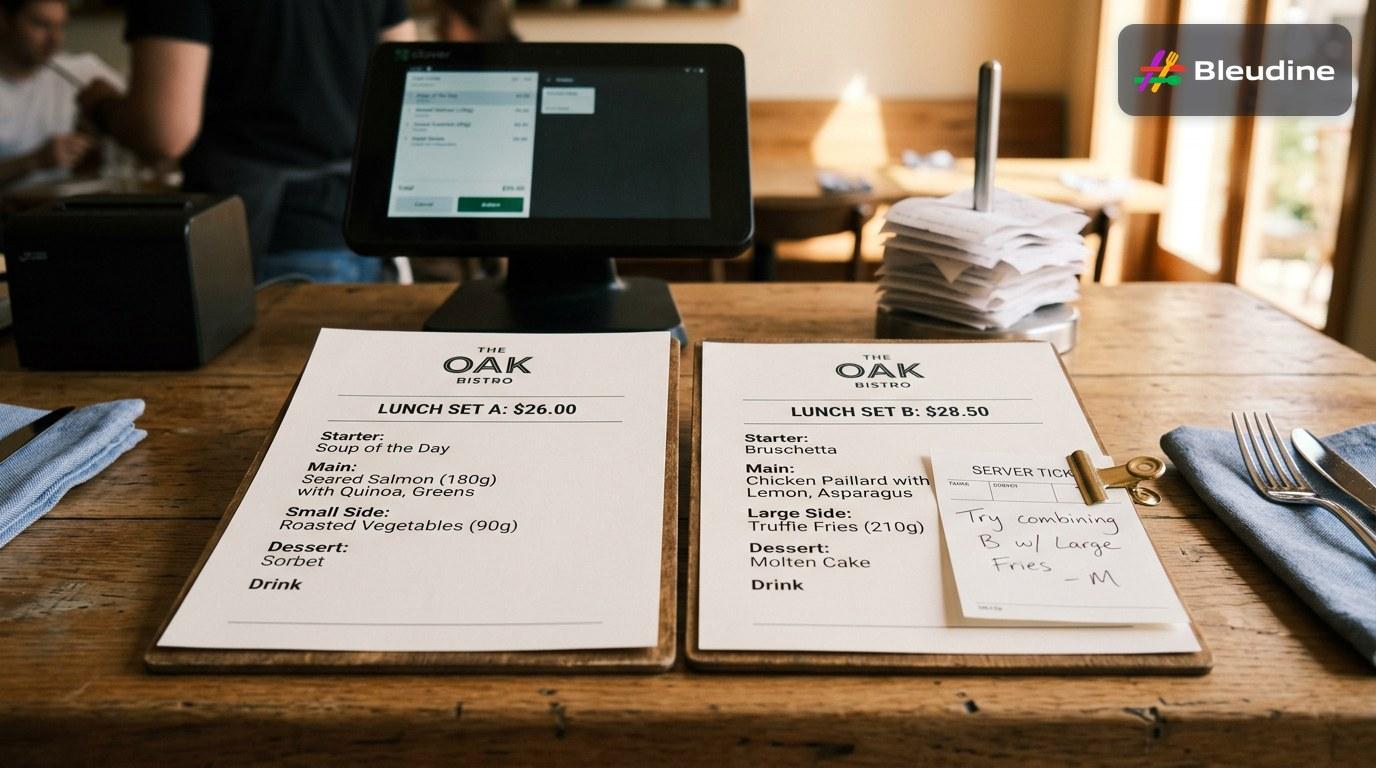
Restaurant pricing works best when you understand how guests compare choices, not just how much each dish costs. Cardinal thinking assigns numeric value, while ordinal thinking ranks preferences. In practice, restaurants win when menu design, bundles, and signature items feel like the better choice on value, portion, and experience.
Bleudine is an F&B operations system for managing outlets, staff, orders, tables, and transactions.
Why ordinal value shapes menu decisions
Where operations software fits into execution
Restaurant pricing is often discussed as a cost-plus exercise, but guests do not buy spreadsheets. They compare choices. Cardinal utility treats satisfaction as a number, while ordinal utility ranks one option above another without claiming exact value. That distinction matters because a menu item only needs to feel better than the alternatives, not mathematically perfect.
For operators, this is why portion size, dish naming, bundle structure, and visual hierarchy can change purchase behavior more than a small price adjustment. A guest choosing between two lunch sets is usually asking, “Which one gives me more value?” not “What is the precise utility score of this item?” Economic theory explains the difference; restaurant execution turns it into revenue.
This is especially relevant in competitive markets like Bali, where restaurants compete on perceived value as much as food quality, according to the market context synthesis in 2026. In that environment, pricing strategy is really menu positioning. A thoughtfully ranked menu can guide customers toward higher-margin items without making the experience feel forced.
Bleudine supports the operational side of that strategy. It creates outlets with menu items, inventory, and operating hours, and it helps manage staff, orders, tables, and transactions. That matters because pricing ideas only work when execution is clean at the outlet level. Bleudine also includes staff binding for receipt printing, which helps daily operations stay consistent while managers focus on menu performance.
The practical takeaway is simple: use cardinal thinking to understand the numbers, but use ordinal thinking to design the customer choice. Restaurants that rank options well usually sell better than restaurants that only calculate cost.
Key facts
- Cardinal utility measures satisfaction in numeric terms, while ordinal utility ranks preferences without assigning exact values. (Economic theory reference, 2026)
- In restaurant pricing, customer perception, portion size, and item comparison often matter more than simple cost-plus pricing. (Restaurant pricing reference, 2026)
- Bali restaurants operate in a crowded market where menu positioning and perceived value are major differentiators. (Market context synthesis, 2026)
- Bleudine supports outlet setup with menu items, inventory, and operating hours. (KB findings)
- Bleudine manages outlet staff and daily workflows such as orders, tables, and transactions. (KB findings)
Frequently asked questions
What is the difference between cardinal and ordinal utility in restaurant pricing?
Cardinal utility tries to measure satisfaction as a number. Ordinal utility only ranks options from more preferred to less preferred, which is closer to how guests actually choose menu items.
Why does ordinal thinking matter for menus?
Because guests usually compare dishes, bundles, and portions against each other. If one option feels clearly better value, it can outsell a cheaper option that looks less attractive.
Is cost-plus pricing enough for restaurants?
Not usually. Cost-plus pricing can protect margins, but it does not account for perceived value, menu hierarchy, or how customers rank alternatives.
How can restaurant operators use this idea عملي?
They can place high-margin items beside anchor items, build bundles that feel complete, and label signature dishes in a way that increases their perceived value.
Does menu design affect sales?
Yes. A strong menu structure can influence what guests notice first, what they compare, and what they feel is the best choice.
Can operations software help with pricing execution?
It helps with consistency. Bleudine supports outlets, staff, orders, tables, and transactions, which makes it easier to execute a pricing strategy across locations.
What matters most in a competitive restaurant market?
Perceived value. In crowded markets, guests often choose the option that feels better, not simply the cheapest one.